Search my reviews and thoughts

Thursday, October 15, 2009

Weezer Posts 'Raditude' Samples on iTunes

Weezer has enabled 30-second samples of the 10 tracks (plus 2 bonus tracks) from their upcoming album 'Raditude' on iTunes. With the purchase of an iTunes pass, fans also have access to weekly album and bonus tracks before the album drops Nov. 3.

The first single from 'Raditude,' "(If You're Wondering if I Want You To) I Want You To" was released August 25. The second song released was "I'm Your Daddy" (available through the iTunes pass).

It's difficult to be surrounded by this Weezer hype without pondering the questions "Will Weezer finally return to form? Or will 'Raditude' simply continue the post-'Maldroit' funk that has descended upon the band?"

Frankly, it's a bit too soon to tell. By looks of this album, the old Weezer may be gone forever. However, I can confidently say that Weezer is going in a positive direction, even if they haven't returned to the level they consistently hit with their first four albums.

15 years after the release of their debut, Weezer seems more youthful than ever. They appear to have grown tired of the same songs and instruments and are trying new things. Pat Wilson has made the shift from drums to guitar, allowing Rivers Cuomo to perform solely as a vocalist. They have also traded in their sweaters for matching sweatsuits, reflective of their new polished sound. These changes are far more welcome than the Red Album's letting each member write a song and sing it (despite it's good intentions).

The last two Weezer albums both had a few good songs each, but 'Raditude' looks like it will have more. Both "I Want You To" and "I'm Your Daddy" are toe-tappingly catchy. And the 30-second sample of "I Can't Stop Partying" (the standout track on Rivers' stellar demo collection) sounds delicious. I can't wait to here Lil' Wayne's verse. The Indian-inspired vocals on "Love is the Answer" are a very pleasant surprise. None of the other samples really jumped out at me, but the mood of the record seems very upbeat and I'm slightly optimistic about it holding together as an album. Perhaps not at the level of the first four albums, but more than the disappointing last two. I hope I have not spoken too soon, but I like this new Weezer!

Saturday, October 10, 2009

Ice Cold Summer


Last year, Heath Ledger captured our hearts with his Joker, one of the most memorable villains in recent film history. But 2009 offers us a villain even more groundbreaking: Summer Finn.

In "(500) Days of Summer" Zooey Deschanel played Summer, the object of protagonist Tom Hansen's affection. The narrator makes it clear at the film's start that it is not a love story. Summer and Tom will not end up together. Joseph Gordon-Levitt gives a pitch-perfect head-over-heels Tom that we can't help but root for (though it is in vain). But Deschanel steals the show with an ice queen performance to rival Tilda Swinton.

What made Ledger's Joker so great was how (for lack of a better word) "cool" he was. For such a sinister character, you really liked him. You wanted to see more of him. In "(500)," the narrator explains that, though Summer does not posses any extraordinary characteristics, she has a certain quality that demands attention. Deschanel hits this right on the head. Just like Ledger, you can't take your eyes off of her. It is Summer's likability that makes her so sinister and sets her apart from other villains.

Is Summer malicious? No. Violent? No. Conniving? Most likely not. Ruthless? You betcha. I felt like I should enjoy the tender moments between Summer and Tom, but I couldn't. Each time, Summer seemed to be stringing Tom along, neglectful of his feelings. She would casually mention that she didn't want a relationship, but continue to spend many an intimate moment with him. Though Tom's intentions were clearly sincere, she plays ignorant and uses him for her own ambitions. At times it even becomes angering to watch Summer ignore the feelings of such an earnest person.

Will Deschanel win an Oscar for her role? Probably not. But she certainly accomplished a lot with it. She invented a new kind of villain. She embodied all that made Summer attractive (quirky, graceful, funny) and still managed to let you hate her. The desire to see she and Tom together was just as strong as the urge to give her a piece of your mind. Isn't that what a villain is supposed to be? Hated and despised? I cannot even imagine feeling anything malevolent towards Ledger's Joker. Though Summer shows little regard for the hearts of others, Deschanel is winning over more and more with each view.

Friday, September 18, 2009

Fit for a King


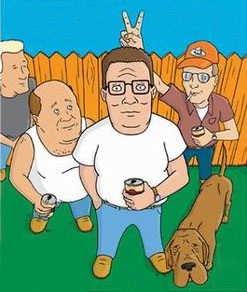
This past Sunday was a sad day for television, though many may not realize it yet. While watching the final episode of "King of the Hill," I reflected on my love for the show. The love I didn't acknowledge until just before discovering it would be taken off the air. Mike Judge has become one of my favorite comedic minds, largely due to "King of the Hill." "King of the Hill" showcases some of the greatest characters around. From the over-the-top paranoia of Dale Gribble to Hank Hill's shudder there is so much to love about these characters.

"King of the Hill" may not supply the gut-busting laughs of say "The Simpsons" or "South Park," but its characters always keep it interesting. The final episode supplied such a fitting conclusion for two of those characters: Hank and Bobby. The finale did not go for the touching moments of the "Buckley's Angel" episode, but it was so satisfying. After struggling to relate with each other for 12 seasons, the father and son finally find something to enjoy together. And it's believable and utterly staisfying.

Friday, September 11, 2009

A Performer's Product

It's now been a few months now since the Academy of Motion Picture Arts and Sciences has announced that the "Best Picture" category of the Oscars will be expanded to 10 nominees in hopes to honor a more diverse collection of pictures. This comes just in time as this year has showcased some great Sci-Fi epics (Star Trek) and animated wonders (Up, Ponyo) that will hopefully receive the respect they deserve.

But there is still one issue that I take with the Academy Awards. The Academy seems to be favoring performances depicting real people in biopics. In the past five years, two of the Best Actress in a Leading Role winners (June Carter, Queen Elizabeth II) and four from Best Actor in a Leading Role (Ray Charles, Truman Capote, Idi Amin, Harvey Milk) have been playing real people. Not that there is no merit in those performances. Indeed actors can show off their range by playing different people very well, but I think we are forgetting the art of creating a character. Actors are artists and can most powerfully show their skill by turning what was only ink on paper into a living person that we care about.

I will begin by saying that I have not seen the film Milk so I cannot argue that Sean Penn did not deserve the Oscar for his performance. But I can push for performances like the one Richard Jenkins delivered in The Visitor. I was very glad that the Academy nominated him for a performance that could have easily been overlooked. But the reason that it could have been overlooked was because of its simplicity. It was not flashy. It did not call much attention to itself. But it may have been the most human performance I have ever seen. It is strange to think that Walter Vale is only a character and does not really exist in this world. Jenkins so completely created a person and for that he deserves an ovation.

It is so hard to label a performance "best" when they are all so different. Sometimes there is a clear-cut winner, but more often the level of excellence among the nominees prompts a vote of preference and not superiority. I simply hope that as we see (hopefully) more diversity in the Best Picture category we will see more diversity in the nominations and winners of the performance categories as well.

Thursday, September 3, 2009

Ponyo


A small number of musicians are able to create a sound that allows an audience to identify them by it almost instantaneously. An even smaller number of filmmakers are able to do so with their work. Hayao Miyazaki is one of those filmmakers. And it is not just the stunning animation that makes a Miyazaki film so identifiable.

"Ponyo," Miyazaki's latest film, feels very similar to his "My Nieghbor Totoro." Both embody youth and playfulness, but run at a very steady, controlled pace. The pace in "Ponyo" doesn't maintain the hypnotic gait of "My Neighbor Totoro" and drags at times, but remains very watchable. But what makes a film like "Ponyo," which features very little action and next to no conflict, so watchable? There is a very elusive, yet tangible, quality that exists throughout Miyzaki's films and can be traced back to the world in which they take place. It is a world Miyazaki seems to visit and revisit so often in his films: a world where people care for one another, where adults trust children, and where love makes anything possible. The attraction to Miyazaki films is rooted in the human desire to belong to such a world.

In "Ponyo," this world takes the shape of a small town on the sea. Miyazaki juxtaposes the majestic depths of the sea with the underwater wasteland that the shallows near the shore have become due to human refuse. This serves as a visual example of just how far humanity is from the magical world Miyazaki creates. But there may be hope for us yet... A young boy named Sosuke rescues a goldfish that is trapped in a piece of garbage. He names the goldfish Ponyo and the two become friends. The friendship comes to a halt when Ponyo's father, a wizard who lives under the sea, retrieves Ponyo from land to bring her home. Driven by her love for Sosuke, Ponyo becomes human and returns to land searching for him.

If the story sounds familiar, it is because it was inspired by Hans Christian Andersen's "Little Mermaid." Miyazaki breathes new life into the tale with some of his most beautiful animation and tender moments to date. Really. This film is moving. Miyazaki's ability to capture the gentle power of love is something to behold. In "Ponyo," love's ability to cause miracles is fully realized. The story is, thematically and literally, about love's ability to change the world.

"Ponyo" is not the most exciting film, but it is one you cannot miss. It is also one that you cannot see just once. Once you have a taste of the magical world of Miyazaki, you will want to return again and again and again. But with every one of Miyazaki's triumphant stories he seems to be urging the audience "This doesn't have to be a place we merely visit. This can be a place we can exist if we trust in love."

Friday, August 14, 2009

Moon


"Moon" is a terrific film that begins like a familiar story, but becomes something uniquely different. Director Duncan Jones sets "Moon" up like cabin fever meltdown story in a habitat on the moon, but then takes a surprising turn which throws actor Sam Rockwell into one of the most unique performances of the year. Rockwell plays Sam, an astronaut who lives by himself in a habitat on the moon to supervise the harvesting of a lunar energy source. Sam is nearing the end of his three-year contract when he begins seeing things. For much of the movie the audience is left guessing at what is real and what is illusion. In the end, we receive a highly satisfying answer.

But satisfaction is hardly the aim of this story. "Moon" deals with exploitation of people by a company that is loyal to only its shareholders. In today's world, the idea of putting someone on moon by himself for three years more than borders torture, but does not seem like much of a stretch given our dissatisfaction with fuel prices. Sam's relationship with a robot named Gerty, his only companionship in the habitat, provokes interesting discussion about the nature of humanity when juxtaposed with the apparent neglect from the humans on earth.

"Moon" features a fresh, exciting story and a touching performance from Rockwell. It is also terribly ominous as we face issues like inhumane treatment and torture within in the United States and grapple with the task finding new sources of energy.

Wednesday, August 5, 2009

"Stranger Than Fiction" *Major Spoilers*

Do not read this article if you wish for the plot of "Stranger Than Fiction" to remain secret. I figure that since the movie is now three years-old it is now safe to discuss the plot. I could give you the gist of the movie and leave you with some idea of whether or not you might like it without divulging the story's details, but those details are necessary in revealing what makes this movie such a success.

"Stranger Than Fiction" should be required viewing material for any aspiring writer, filmmaker, or producer of any media, not because of excellence in craft (it is nothing extraordinary in that department), but because of its powerfully relevant metaphor of an artist's responsibilities.

Will Ferrell plays Harold Crick, a middle-aged IRS agent who lives every day on a meticulous schedule. One day he hears a voice narrating his every move to him, and very accurately. The voice is merely a nuisance to Harold until it predicts his death. With the help of a Literature Professor, played by Dustin Hoffman, Harold discovers that the voice he hears is the voice of Karen Eiffel, an author who always ends her stories with the protagonist's death. Harold, with his IRS resources, tracks down Karen and confronts her. It turns out that Karen is in the process of writing a novel about Harold Crick, a character she believed to be fictional. She is also trying to find the perfect way to kill Harold in her story.

After meeting each other, Harold and Karen are both convinced that if she finishes the story with Harold's death, Harold will die in real life. Karen discovers the perfect way to kill Harold and gives him a handwritten ending of the story (before typing it in her typewriter, making it official). Harold gives the ending to the professor who tells him that it's the perfect story. He urges Harold to let Karen use that ending because it would be the most poetic ending, even if it means Harold's death. After reading the ending, Harold gives Karen his blessing, agreeing that the end is perfect.

SPOILER. After a series of events we find Harold lying in a hospital bed: battered, bruised, and very much alive. Karen brings the finished story to the professor, complete with her updated ending. The professor tells her that story is okay, but not the masterpiece that it was when Harold died. You know what? Karen is okay with it.

We live in an age where the stories we are told (movies, books, television) and the stories we participate in (video games) are full of sex, drugs, and violence. Children are conditioned to think that promiscuous sex can be romantic, alcohol can be a gateway to romance, and those who use guns and swords to solve their problems are heroic. Is it any wonder that rape, suicide, and murder are so rampant? The worst part is that the storytellers bear no responsibility for their actions. With their First Amendment rights, they will never be forced to leave those certain elements out of their stories, but they can choose to leave them out. Use Karen Eiffel as an example. She chose protecting a human being over writing a great story. Even if a story can be told more poetically with sex or violence, is it worth it? Is it worth being told at all? At whose expense is art gaining merit? The children of the world face enough tribulations as it is and deserve some real heroes to look up to. Even if it means they won't be quite as entertained. Are innocent lives the price we pay to make art?