Search my reviews and thoughts

Tuesday, May 18, 2010

A Dumb Heart


Behind all the outrageousness and all around hilarity of the Farrelly Brothers’ classic “Dumb and Dumber,” is a rather tender heart. Lloyd is a professional chauffeur who becomes infatuated with one of his customers, Mary. Lloyd picks up a briefcase that Mary left behind before flying to Aspen, CO. He wants to travel to Aspen to return the briefcase and, more importantly, see Mary again, but his roommate, Harry, doesn’t want to. Lloyd convinces Harry with this speech: “You know what I'm sick and tired of, Harry? I'm sick and tired of having to eke my way through life. I'm sick and tired of bein' a nobody. But most of all I'm sick and tired of havin' nobody.” That quote sparks the cross-country road trip that propels to the story forward, but it is also key to the emotional core of the movie.

Lloyd is in a position familiar to many, he likes someone who doesn’t like him back. He decides to take a chance on her though. He travels across the United States for her only to have his best friend betray him. Lloyd witnesses Harry cavorting with her in Aspen and it breaks his heart. In the end, the two friends get over the bad blood and are portrayed as very content. They didn’t gain anything. Neither one got the girl. They just had each other and that was enough. The story is very representative of the human cycle of dissatisfaction.

Lloyd was convinced that Mary would improve his life. When he considered his life without her, he said that he had “nobody,” but he really had somebody. He had Harry. The audience understands that having Harry was enough all along. So often, we convince ourselves that life would be better if only a certain thing changed. But if even we achieve that change, we eventually find something else to make us dissatisfied. As the late Michael Crichton wrote, “As a rule, nothing you lack now will make you happy when you get it.” But realizing that rule doesn’t stop our feelings of dissatisfaction from causing distress. “Dumb and Dumber” very accurately portrays both Lloyd’s conviction in his belief that he needed Mary and the pain and heartache it caused him. We already have everything we need to be happy and we must hold fast to that belief. It is so easy to feel dissatisfied and struggle to see the good in life, but it is especially those moments that require great faith. We already have everything we need.

Sunday, May 9, 2010

Writing A Great Song

I wonder what it’s like to write a great song.

I wonder if Tracy Chapman knew what a beautiful thing she had created when she was hammering out “Fast Cars” on acoustic guitar for the first time. Did she feel empowered to have written something so wonderful? I wonder what Primitive Radio Gods felt like after recording “Standing Outside a Broken Phone Booth With Money In My Hand.” Were they afraid that they may never write anything that good again? Does an artist give up because they feel they’ve already done their very best?

At which part of the process does that artist realize how great the song is? Johnny Rzeznik of the Goo Goo Dolls admitted that he never thought his song “Name” was anything special. He just stuck it in the middle of “A Boy Named Goo” to take up space. Now it is one of the band’s most beloved songs. I wonder if the process was different with “Iris” (gag all you want, but it’s moving). Did he have a hunch that he might have something great on his hands while the song was still in its premature stages? Did that feeling not come until the grand string sections has been added?

Perhaps an artist never really knows that something is great unless the audience gives its blessing. But what if that artist-audience communication never exists? It’s possible that a musician’s song is moving someone in the world and he or she will never know about it. An artist may write a song off without ever knowing that it’s someone’s favorite.

Wednesday, April 14, 2010

Owen Pallett - Heartland


Owen Pallett (formerly known as Final Fantasy)’s newest album is entitled Heartland and appropriately so (assuming that Heartland refers to some sort of place). The album suggests a place, or rather an adventure through it. I imagine journeying through some sort of bizarre world as I listen to the album. The world I picture is neither lovely nor menacing, but rather something in between. It’s something uniquely captivating. And it’s one heck of a voyage.

The first few songs sound like they belonged on a soundtrack to a Tim Burton movie. I can’t say I was completely enamored, but I was very intrigued. “The Great Elsewhere” marks a clear turning point in the album. You go from voyeur, taking in the sights and sounds of Heartland, to someone facing it head-on. Pallett seems to be grabbing you by the shoulders and demanding your attention. Though the beginning of the album is simply interesting, “The Great Elsewhere” is absolutely moving. “Oh Heartland, Up Yours!” and “Lewis Takes Off His Shirt” complete the stunning three-song halfway point of the journey. The former with a beautiful melody, laced with sorrow, and the latter with a triumphant chorus.

The rest of the album reverts back to journey mode, but with a new perspective. The melodies are more affecting; you have clearly gone deeper into Heartland. The album ends very abruptly with “What Do You Think Will Happen Now?,” but I imagine it is intentional. The final song feels like it should lead into another, but there is nothing else. Pallett asks the listener what he or she thinks will happen now and leaves it up to the listener’s opinion. It seems to suggest that there is more to Heartland than has been revealed to us. I, for one, couldn’t be more thrilled. I love that place.

Wednesday, April 7, 2010

1940's Japan is Close to Home


“Grave of the Fireflies” is considered Isao Takahata’s masterpiece. The Japanese animator wrote and directed “Fireflies,” which is based on Akiyuki Nosaka’s autobiographical account of the World War 2 firebombings. In the film, Seita is a teenage boy who loses his mother to the bombings while his father is serving in the Navy. He is forced to care for his young sister Setsuko by himself. This anime classic is often considered one of the greatest war (anti-war) films, but its themes are by no means confined to wartimes.

Seita and Setsuko first go to live with their aunt after losing their home and mother. Though she is hospitable at first, the aunt begins to turn on Seita. She calls him lazy and tells him that he should help Japan by fighting the fires, not hiding from them with his sister. She refuses to feed Seita and Setsuko rice (which she gives to her own children) because Seita doesn’t do anything. Another adult tells Seita to be brave like his father, echoing the aunt’s opinion.

Every character in the film fails to see Seita’s bravery. He eventually leaves the aunt’s house because he feels unwelcome and makes a home out of an air-raid shelter. He struggles mightily to provide food for Setsuko and keep her spirits up, but no one acknowledges it. No one considers caring for Setsuko to be legitimate work. Though the film is more than 20 years old and it takes place in the 1940’s, its message is still very relevant.

An under appreciation for childcare still exists throughout the world today. Fathers who chose to be primary caregivers are considered lazy, just as Seita was. Seita’s harshest critic was his aunt, a woman and a caregiver herself. Both women and men buy into the notion that childcare is woman’s work and that woman’s work is considered less important. “Fireflies” cries out for all those under appreciated caregivers, male and female. Seita’s struggle was so great and he was offered no assistance or recognition. He struggled until it broke him (don’t worry, the first scene of the movie shows him dying alone so it’s not a spoiler). Who are we allowing to break?

Monday, April 5, 2010

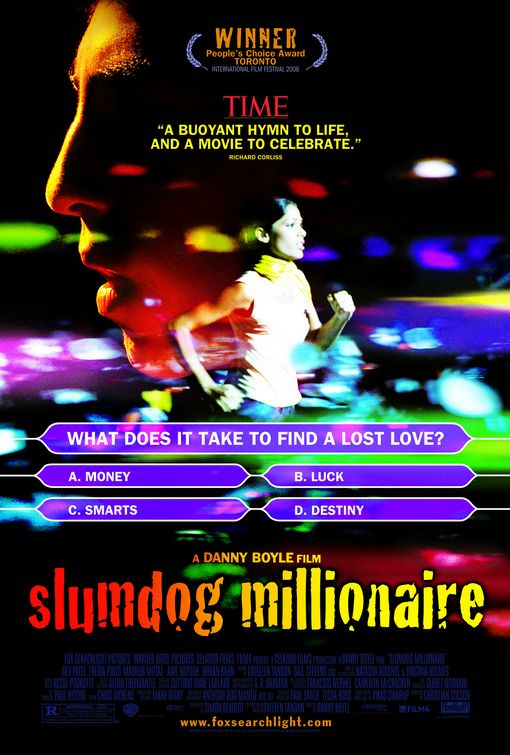
Dust It Off: Slumdog Millionaire SPOILERS


I am assuming that the reader has seen the movie already.

The "climactic" moment of "Slumdog Millionaire" cuts back and forth between Jamal awaiting the answer to the final question and Salim sitting in a tub full of money, preparing to kill the head gangster guy.

The first time I saw the movie, I was distressed by this scene. It culminates with a montage of images: Jamal winning the money, fellow 'slumdogs' pouring into the streets in celebration, and Salim shooting the gangster just before being shot himself. I didn't like how Jamal's problems needed to be solved with violence (by Salim) when the film had supported gentleness up to that point.

By my fourth viewing, I saw the film in a different light. I realized that, even though Jamal winning the money was the most celebrated moment, it was not his victory. Jamal had already received what mattered: Latika's safety. The fortune didn't really matter. Everyone celebrated the fortune, except Jamal himself. This celebration was juxtaposed with the image of Salim killing and being killed in a tub of money. The montage seemed to suggest the naivete of those celebrating. Money does not bring happiness. Jamal always knew that, but Salim realized it too late. As a result, Salim met his fate in a pool of its source: money and greed. The shooting scene was not a moment of triumph, but one of tragedy. The struggle for human connection through love begot the true victory of the film: Jamal and Latika reuniting.

Monday, March 29, 2010

Tegan and Sara - Aragon Ballroom 3/26


Tegan and Sara played the Aragon Friday night. I listen to them all the time. I saw them perform at the Hollywood Bowl this summer and was a bit underwhelmed. I assumed it was because the venue was so enormous and the sound system didn’t pack much of a punch, but I had a similar experience at the Aragon.

One reason for not having my potential for enjoyment maximized may have been the song choices. They began with “The Ocean,” which was really dull, then played “On Directing,” which picked things up a bit, but then played “The Cure,” which dragged again. All of those songs are on their newest album, “Sainthood,” which I’m not the biggest fan of. Most of the songs that I do like on that album are Sara songs (ie. “On Directing”). Tegan’s are pretty weak (ie. “The Ocean” and “The Cure”). If they were to play the best “Sainthood” songs, Tegan wouldn’t be singing very many of hers. Perhaps they try to balance the number of songs. Normally I wouldn’t oppose, but “Sainthood” is so Sara-heavy that the balance worked to their disadvantage. They may have also considered it cliché to open with the first track of their newest album, but “Arrow” would have been a much better opener that “The Ocean.”

I think I also realized that I’m not a big fan of their style live. Both girls are charming and fine musicians (along with the band), but don’t possess much stage presence. I wanted to see some swagger. They also change guitars between every song. I don’t know much about alternate tunings, but it would behoove them to consider grouping similar tunings when planning the set. They lost so much momentum between songs.

I love listening to Tegan and Sara records, but they just don’t put on a very dynamic performance. I’m sure some people really loved the show, but me? Well, I like everything big. I didn’t dislike the show, I was just a bit unsatisfied.

Wednesday, March 17, 2010

2010 Irwies


It's that time of year! That's right, the second annual Irwie Award presentation. Irwies are awards presented in honor of the late Steve Irwin honoring people, things, or phenomena that have made a significant dent in the realm of pop culture over the past year.

Here we go!

Achievement in Douchebaggery - Spencer Pratt.

For beginning the process of legally changing his name to “King Spencer Pratt.” Seriously. No idea if it’s officsh yet. You got lucky Kanye. Disrespecting T-Swift like that was pretty douchey. And count your blessings NBC. You guys might not be so dumb after all- choosing one of the douchiest years in recent memory to do Conan bogus like that.


Song of the Year - “Hawaii” by Mew

It’s big. It’s pretty. Holy cow. Just listen to it.


Artist of the year – Woody Harrelson

“The Messenger” gave Harrelson Golden Globe and Oscar nominations for best supporting actor and “Zombieland,” which gave him a much-deserved starring role, garnished rave reviews. Unfortunately I haven’t seen either of those. But I have seen “2012.” And let me tell you, what a performance! Harrelson is the best part of the movie. Better than the epic special effects. Better than those two old ladies. 2009 will forever go down as the Year of Woody!


Heartbreak of the Year – Frusciante’s Exit

Now I love Billy Mays as much as the next guy and I’ll be the first to tell you that Conan got shafted (though I have to admit, I didn’t watch him as much on The Tonight Show as I did on Late Night), but this is downright sad. John Frusciante, the guitarist of the Red Hot Chili Peppers, has stepped down. I am a little biased, but I consider Frusciante’s visionary work to be the driving force that lifted the Chili Peppers to rock’s upper echelon over the last decade. I’m sure the new guy can play, but I have a feeling the Chili Peppers are going to miss Frusciante’s songwriting. He has such a musical ear and that is not easily replaced. Frusciante claims that the intrigue he once found in the Chili Peppers has now manifested in his solo music and I think he should pursue what he is passionate about. Frusciante is one of the great musicians of this era and I will take great music from him in whatever form I can get it, but I will miss him as a member of the Chili Peppers.


Greatest Guilty Pleasure – Jersey Shore

I can’t believe that “2012” isn’t receiving this award, but “Jersey Shore” is like a car wreck that you can’t look away from. A buff, tan, fake-boobed, Ed Hardy-clad car wreck. By the end of the season the episodes become a bit repetitive, but I have such fond memories of the show: particularly The Situation and Pauly D trying to “smoosh” with their respective girls in the same bedroom.
(Note: Justin Bieber was not considered in this category because I am legitimately proud to be a fan of his).


And last but certainly, certainly not least...

Stone Cold Fox of the Year

Rachel Berry. Yes the character. Not the actress, Lea Michele, who plays her. Yes, I know that Lea is lovely. And yes, I know that Rachel’s not real. There’s just something about her. I went through the entire first season of Glee in under 80 hours and I solely blame Rachel Berry for that. I’ve watched interviews with Lea Michele on youtube and it just isn’t the same. Something about those dorky clothes and abrasive attitude really rev my engine. And call me old fashioned, but Rachel being a high school sophomore doesn’t hurt either. (I can say that if she’s not real, right?).