Search my reviews and thoughts

Thursday, September 3, 2009

Ponyo


A small number of musicians are able to create a sound that allows an audience to identify them by it almost instantaneously. An even smaller number of filmmakers are able to do so with their work. Hayao Miyazaki is one of those filmmakers. And it is not just the stunning animation that makes a Miyazaki film so identifiable.

"Ponyo," Miyazaki's latest film, feels very similar to his "My Nieghbor Totoro." Both embody youth and playfulness, but run at a very steady, controlled pace. The pace in "Ponyo" doesn't maintain the hypnotic gait of "My Neighbor Totoro" and drags at times, but remains very watchable. But what makes a film like "Ponyo," which features very little action and next to no conflict, so watchable? There is a very elusive, yet tangible, quality that exists throughout Miyzaki's films and can be traced back to the world in which they take place. It is a world Miyazaki seems to visit and revisit so often in his films: a world where people care for one another, where adults trust children, and where love makes anything possible. The attraction to Miyazaki films is rooted in the human desire to belong to such a world.

In "Ponyo," this world takes the shape of a small town on the sea. Miyazaki juxtaposes the majestic depths of the sea with the underwater wasteland that the shallows near the shore have become due to human refuse. This serves as a visual example of just how far humanity is from the magical world Miyazaki creates. But there may be hope for us yet... A young boy named Sosuke rescues a goldfish that is trapped in a piece of garbage. He names the goldfish Ponyo and the two become friends. The friendship comes to a halt when Ponyo's father, a wizard who lives under the sea, retrieves Ponyo from land to bring her home. Driven by her love for Sosuke, Ponyo becomes human and returns to land searching for him.

If the story sounds familiar, it is because it was inspired by Hans Christian Andersen's "Little Mermaid." Miyazaki breathes new life into the tale with some of his most beautiful animation and tender moments to date. Really. This film is moving. Miyazaki's ability to capture the gentle power of love is something to behold. In "Ponyo," love's ability to cause miracles is fully realized. The story is, thematically and literally, about love's ability to change the world.

"Ponyo" is not the most exciting film, but it is one you cannot miss. It is also one that you cannot see just once. Once you have a taste of the magical world of Miyazaki, you will want to return again and again and again. But with every one of Miyazaki's triumphant stories he seems to be urging the audience "This doesn't have to be a place we merely visit. This can be a place we can exist if we trust in love."

Friday, August 14, 2009

Moon


"Moon" is a terrific film that begins like a familiar story, but becomes something uniquely different. Director Duncan Jones sets "Moon" up like cabin fever meltdown story in a habitat on the moon, but then takes a surprising turn which throws actor Sam Rockwell into one of the most unique performances of the year. Rockwell plays Sam, an astronaut who lives by himself in a habitat on the moon to supervise the harvesting of a lunar energy source. Sam is nearing the end of his three-year contract when he begins seeing things. For much of the movie the audience is left guessing at what is real and what is illusion. In the end, we receive a highly satisfying answer.

But satisfaction is hardly the aim of this story. "Moon" deals with exploitation of people by a company that is loyal to only its shareholders. In today's world, the idea of putting someone on moon by himself for three years more than borders torture, but does not seem like much of a stretch given our dissatisfaction with fuel prices. Sam's relationship with a robot named Gerty, his only companionship in the habitat, provokes interesting discussion about the nature of humanity when juxtaposed with the apparent neglect from the humans on earth.

"Moon" features a fresh, exciting story and a touching performance from Rockwell. It is also terribly ominous as we face issues like inhumane treatment and torture within in the United States and grapple with the task finding new sources of energy.

Wednesday, August 5, 2009

"Stranger Than Fiction" *Major Spoilers*

Do not read this article if you wish for the plot of "Stranger Than Fiction" to remain secret. I figure that since the movie is now three years-old it is now safe to discuss the plot. I could give you the gist of the movie and leave you with some idea of whether or not you might like it without divulging the story's details, but those details are necessary in revealing what makes this movie such a success.

"Stranger Than Fiction" should be required viewing material for any aspiring writer, filmmaker, or producer of any media, not because of excellence in craft (it is nothing extraordinary in that department), but because of its powerfully relevant metaphor of an artist's responsibilities.

Will Ferrell plays Harold Crick, a middle-aged IRS agent who lives every day on a meticulous schedule. One day he hears a voice narrating his every move to him, and very accurately. The voice is merely a nuisance to Harold until it predicts his death. With the help of a Literature Professor, played by Dustin Hoffman, Harold discovers that the voice he hears is the voice of Karen Eiffel, an author who always ends her stories with the protagonist's death. Harold, with his IRS resources, tracks down Karen and confronts her. It turns out that Karen is in the process of writing a novel about Harold Crick, a character she believed to be fictional. She is also trying to find the perfect way to kill Harold in her story.

After meeting each other, Harold and Karen are both convinced that if she finishes the story with Harold's death, Harold will die in real life. Karen discovers the perfect way to kill Harold and gives him a handwritten ending of the story (before typing it in her typewriter, making it official). Harold gives the ending to the professor who tells him that it's the perfect story. He urges Harold to let Karen use that ending because it would be the most poetic ending, even if it means Harold's death. After reading the ending, Harold gives Karen his blessing, agreeing that the end is perfect.

SPOILER. After a series of events we find Harold lying in a hospital bed: battered, bruised, and very much alive. Karen brings the finished story to the professor, complete with her updated ending. The professor tells her that story is okay, but not the masterpiece that it was when Harold died. You know what? Karen is okay with it.

We live in an age where the stories we are told (movies, books, television) and the stories we participate in (video games) are full of sex, drugs, and violence. Children are conditioned to think that promiscuous sex can be romantic, alcohol can be a gateway to romance, and those who use guns and swords to solve their problems are heroic. Is it any wonder that rape, suicide, and murder are so rampant? The worst part is that the storytellers bear no responsibility for their actions. With their First Amendment rights, they will never be forced to leave those certain elements out of their stories, but they can choose to leave them out. Use Karen Eiffel as an example. She chose protecting a human being over writing a great story. Even if a story can be told more poetically with sex or violence, is it worth it? Is it worth being told at all? At whose expense is art gaining merit? The children of the world face enough tribulations as it is and deserve some real heroes to look up to. Even if it means they won't be quite as entertained. Are innocent lives the price we pay to make art?

Saturday, July 25, 2009

"Sundays at Tiffany's" by James Patterson

Sundays at Tiffany's begins with Jane, a young girl with a wealthy diva for a mother named Vivienne. Jane appears shy and misunderstood and she seeks refuge in her relationship with her imaginary friend, Michael. It later appears that Michael, a handsome and charming thirty-something, is more invisible than he is imaginary. Michael leaves Jane promising that she will forget him completely. Fast forward about 24 years and Jane is working an unsatisfying job for her mother, is in an unsatisfying relationship, and still has not forgotten Michael.

I read this book because I was in the mood for feel-good romance. I have to admit that the premise for this book is original. I also enjoyed the element of fantasy in the book as it relates to imaginary friends actually existing outside of children's imaginations. We find Michael in between "jobs" (children to befriend and guide). He lives a seemingly normal life in New York City, is completely visible, and possesses a few neat powers.

Then Michael sees grown-up Jane. He is hesitant to approach her because it breaks some sort of "imaginary friend code' or something. They eventually meet and start to develop a relationship. This is where the book begins to spiral out of control. Not that it was in much control to begin with. Yes, the interpretation of imaginary friends is unique, but Patterson's/Charbonnet's prose is the ultimate downfall. Tiffany's is a story of love and destiny. A very poetic type of storytelling is required to convey that emotion; and Patterson just doesn't have it. I think he equates sappy with poetic because this story is not short on sap. Not by a long shot. Patterson also only describes the love between characters by writing variations of "she loved him" or "he loved her so much." This got tired fast. Still, for all that awful sappiness I still felt compelled to finish it. And I got through it very quickly. It doesn't drag (thank God), but it's definitely not worth the effort.

Tuesday, July 21, 2009

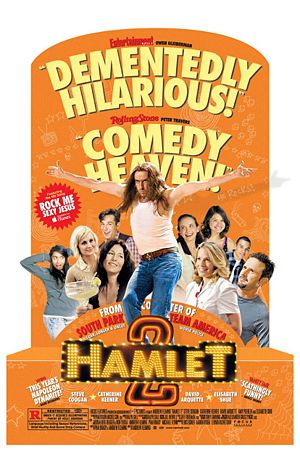
Hamlet 2

Hamlet 2 stars Steve Coogan as an actor-gone-high school drama teacher. His lackluster productions lead the school board to cut funding for the drama program on the eve of his original play intended to save the department: Hamlet 2. This sequel has Hamlet traveling through time with Jesus for some reason and is viewed as highly offensive by many. As a result, the school decides to cancel the play. But Coogan's character is bent on performing his baby.

Quite the premise.

Unfortunately, the film doesn't live up to the premise. The only funny moments in the film are when we see characters rehearse the play or discuss its scenes. This really builds up expectations for the final performance which doesn't end up being funny at all. It is built up to be so scandalous, over-the-top, and crossing the line, but in the end Hamlet 2 (play and film) is just not that outrageous. I was very frustrated because the premise and its star, Coogan, obviously have so much potential. But instead of relying on shock humor (I expected something in the vein of Matt Stone and Trey Parker) it settles for uninspired slapstick and unoriginal urban-meets-suburban student interactions.

Hamlet 2 was a vehicle built to soar, but never manages to lift off the ground.

Monday, July 13, 2009

Death Cab for Grammar

Continuing my previous rant on Death Cab for Cutie (a band I actually casually like)...

Something I have always taken issue with is the lyric "the rhythm of my footsteps crossing floodlands to your door have been silenced forever more" from the terrific song "Transatlanticism." The lyric is beautiful, descriptive, and moving... on opposite day! It should actually read "has been silenced forever more." The subject of the sentence is "rhythm," but it is written as if "footsteps" (the object of the preposition) is the subject. "Of my footsteps crossing floodlands to your door" is the prepositional phrase and should be removed when conjugating the verb. Once it is removed you are left with "the rhythm have been silenced forever more," making it obvious that "has" should be used instead of "have." The rhythm was silenced, not the footsteps themselves.

Now this is not a big deal. I post so many egregious errors on this blog that I often cringe when I go back to read my entries. The difference is, once I realize the error, I fix it. I realize that Death Cab cannot change the studio recording of "Transatlantacism," but I thought that they might revise the lyric when they perform it live. On Sunday July 5 at the Hollywood Bowl, much to my dismay, Ben Gibbard sang the word "have." Oy vey!

Friday, July 10, 2009

The New Pornographers, Tegan and Sara, and Death Cab for Cutie at the Hollywood Bowl 7/5/09

I must say that my first trip to the Hollywood Bowl was a very good one. It was a perfect night to be outside, the scenery was very pretty, and the venue's size did not hinder my enjoyment as much as I expected. My one qualm was with the sound. Though clear, the sound of more "rocking" songs seemed a bit wimpy. But I suppose this is understandable as the venue was intended for orchestral music, not rock and roll.

The New Pornographers took the stage first and played a very tight 30-minute set. Their performance of "Challengers" (the most acoustic song of their set) was very good and displayed gorgeous harmonies, but the chatter of the crowd took a lot away from the moment. It's too bad because that was the one song not hindered by the sound of the Bowl. There are a few songs I wish they would have played, but in 30 minutes they couldn't please everyone. I am pleased with what I got: a well-performed high-energy set of great music. The only issue I took was that singer A.C. Newman seemed to struggle with the harmonies of the last two songs "Sing Me Spanish Techno" and "The Bleeding Hearts Show." I doubt that this was an isolated incident because I couldn't imagine his voice hitting some of the notes on any occasion.

Tegan and Sara were up and running within 15 minutes of the end of the Pornographers set. Their first song, "Dark Come Soon," grabbed the audience's attention right away, but they were unable to keep that very firm grip. They used a good balance of banter and music to keep the audience engaged within their allotted 45 minutes, but suffered from what appeared to be a lack of practice. They played a gig in Seattle two days earlier, but are not currently touring and probably have not had tremendous amounts of rehearsal time with the band. Some of the transitions were a little sloppy and left the songs feeling less than dynamic. "Living Room" was the only song from their first two albums in their "Con"-heavy set and I was left wishing for a bit more diversity. I really enjoyed finally seeing Tegan and Sara live for the first time, but felt like seeing them headline a smaller venue would be much more fitting. "Nineteen" and "The Con" would probably rock more with a louder sound system and people would not be chatting during their quiet numbers. So this was basically a tease for me.

Then Death Cab for Cutie took the stage. I feel like I should begin to describe their set at the end of it: 17,000+ people on their feet, applauding as though they had just seen one of the most riveting performances in recent music history. Because they had... for about 8 minutes. Death Cab opened without the Philharmonic with a rocking "Marching Bands of Manhattan" and made cool transition from a song I'm not familiar with into "The New Year," but that was about all I liked about the first half of the set. The privilege of watching Chris Walla shred wasn't even enough to keep me interested. I admit I'm kind of growing tired of Death Cab, I don't like their new music at all, and I was bitter that such a mediocre band would sell out such a huge venue. So this review is a bit biased. I got my wish and they played "Summer Skin," but they didn't do it with the Philharmonic which continues to puzzle me.

After about 40 minutes, they left the stage promising to return with the Philharmonic. I have to admit that adding all those instruments made their sound much more dynamic. I don't really understand their insistence on rocking with songs like "Movie Script Ending" when more melodic songs (like "Summer Skin") really could have benefitted from the orchestra. After about 30 minutes of slightly improved music the audience was brought to the previously mentioned 8 minutes of euphoria. Yes, I am talking about the "Transatlanticism" finale with the LA Philharmonic in tow that I new was coming. I expected it, but I never could have been ready for it. The performance was great and the Philharmoic added beautiful texture. I was afraid they would make the song too busy, but they were able to evoke the wide-open ocean sound that they do so well on the record. And just when I thought it couldn't get better, the fireworks began. It was such a perfect visual and audial crescendo. Really perfect. I can't think of a performance that made me feel like that. It's amazing how a good finale can make you forgive an hour of mediocrity.